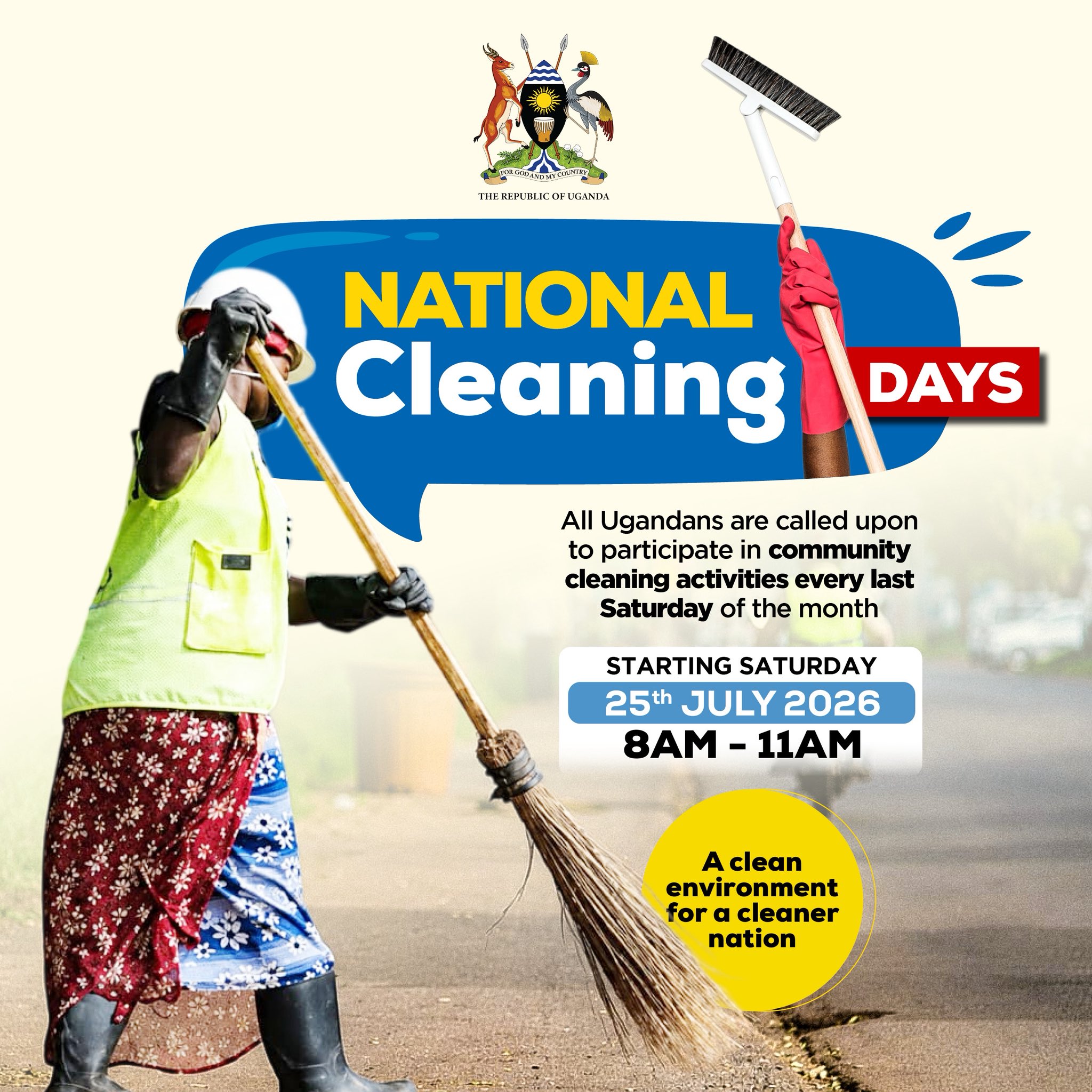
Last Saturday, 26 September 2026, marked the third edition of the recently launched National Cleaning Days in Uganda. The designated days shall be the last Saturday of every month. Usual business is halted to allow for public general cleaning, including sweeping streets and roads, clearing blocked drainage channels, picking up litter, and collecting waste for its safe disposal. The mandatory event is to be observed by everyone from 7 o’clock to 10 o’clock in the morning, during which a movement curfew shall be imposed; emergencies and security movements are the exception.
Reception for the public holiday remains mixed, with some criticising the program as a cheap government scapegoat for its failed duty of managing public and environmental health. A considerable section has welcomed the initiative, but recommended that it could have been launched and implemented better, citing concerns such as public sensitisation, capacity building to deal with the collected waste, an impromptu curfew, and religious objections from the Seventh-day Adventists who keep Saturday as Sabbath, a day of rest and spiritual meditation.
Certainly, when the program was launched, it was unannounced, and the day fell on us like an act of God, affecting many programs. Now, we all know, and that excuse is now past. Nonetheless, I still hold some reservations, as a patriotic citizen who fancies good governance, if I may add. I should share my concerns, but that will be later and elsewhere. Here, I want to talk about how the national cleaning days have been adopted by Ugandans.
‘When the hunter learnt how to shoot without missing, the bird learnt how to fly without perching.’ That summarises the cat-and-rat relationship between Ugandans and the Government. The score is to hit and run and not be caught. If you don’t “speak the language”, you may be caught. That’s why bribery persists. The atmosphere is suspicious. That’s why, when you meet any state personnel, the reflex is to check whether your hideout is compromised and, if not, to ask who has been netted and is about to be caught. The signal is the presence of security agencies. Perhaps foreigners feel safest in such situations, but a true Ugandan will know that’s the unsafest place to be. It’s really a mindset that has grown from the turbulent times of past political regimes. The unfortunate consequence is that most government programs are seen either as bait or scapegoats for some sinister schemes. Which should not be, of course.
This governance tension does not come without drama. The Government may have the might, but Ugandans are also wise. For example, though unrelatedly, when Facebook, the most widely used social media network at the time, was banned in Uganda in January 2021, Ugandans adopted virtual private networks, and although traffic reduced considerably on the site over the next five years while it stayed banned, those with significant audiences continued to publish content as usual. The irony was that Government accounts also bypassed the ban and continued to engage (I don’t know which citizens) on Facebook. A few months ago, the ban was lifted, albeit with a few limitations. Ugandans had long won that battle; the Government just chose to be adamant!
We had moved on, like we do for those photos that we don’t want but don’t have the time to skim through Google Photos to delete them. When the storage gets used up, we delete a few large files to save space for important mail, and then create a new Gmail account. And so, the government may have forced us to wake up early on that hard-earned Saturday weekend holiday, pick up a broom or spade and go out and clean the poor drainage channels for unplanned buildings and bad roads, restricted our Saturday plots for fun and other functions with friends and family, and even beaten some of us for apparently being anti-social and unpatriotic during the cleaning hours, but Ugandans will always find a way of ending the match in a draw, at least.
A month ago, during the second edition of the national cleaning exercise, I learnt with fascination that Ugandans had adjusted their travel plans for the fateful Saturday. For folks planning any event for the cleaning day, the plan is no longer to wait for 10.00 am to set off for the venue. In fact, if the planned arrival or commencement time was 11 am, it remained unchanged despite the obvious effect of the cleaning curfew. Highway motels and hotels record the busiest nights on the eves of the cleaning days. Night travel is the adjustment. Friday ends normally. Work, school for children, home, supper, prayers. Even tuck the children into bed. Then park and head out for Saturday. The rendezvous is a secluded inn about 30 minutes away from the venue by private car. If couples didn’t have time for each other, the national cleaning days are a spot-on opportunity to clean up their relationships in one of those hotels and Airbnbs. From where I hail, I can already see the emergence of seasonal names like Eve Kuyonja, Kayonjo, Clean, Saturday, etc.
Today, I learnt, with amazement and disbelief, about another innovation from one of my usual boda boda riders. Someone should confirm with a waste collection company whether they know about this, but the news is that these garbage collectors have recorded reduced incomes, especially in town neighbourhoods and around trading centres. For most places around the capital city, Kampala, waste collectors charge an average fee of about UGX 30,000/= per month for ordinary house/home and business waste. The collection is weekly, and such company trucks move around homes and businesses picking up rubbish and waste. There was not much fuss about the collection fees because they are regulated by the area local government councils. And that’s where the problem lay. There was limited choice for people in paying the fee. In the end, the waste collection, which was logically contracted out to select companies, was regarded as another undue tax.
To the ordinary city dweller, if there is a business which cannot be freely entered into, that’s corruption, and that’s segregation of the citizens from their right to do a similar business. While the concessionaire companies have provided jobs to the people, Ugandans would prefer a service/business opportunity rather than a job opportunity. If you have a modern waste collection truck, but I can afford a wheelbarrow, I want to be allowed to do the business just as you do. Again, because the atmosphere is suspicious, Ugandans are not sure whether those companies are from the private sector or they are owned by Government officials wearing a private mask. It’s really an issue of basic public/environmental health literacy. It’s not so much about how badly the Ugandan Shilling is doing against the American Dollar, or how much money is needed to secure the Village Chairperson Seat. (Please excuse my misplaced responses to my boda boda guy’s opinions.)
But when all hope was lost, a silver lining came through the national cleaning days. Suddenly, it’s not about the forced public chores anymore; the waste management system has just been liberalised. Why should I pay the private waste collector when KCCA (or your area local government council) will freely collect all the garbage on the last Saturday of the month? These past weeks, it’s been like the biblical Passover for most waste collectors. Homes and neighbourhoods have colluded to store their month’s waste for the cleaning Saturday, and every time a waste handler from these companies came around, the reply was the same chorus: We don’t have kasasiro “garbage”!
Little wonder, in the third edition, the collected waste piles have hit a record mass! They are not about to reduce. The garbage will keep increasing. The people will keep showing up in larger numbers, not for the public cause, but for the private affair of ferrying their smelly heaps of stored garbage to the designated roadside collection points. And these heaps will continue to stay for longer periods because KCCA cannot transport all this waste on that day to the various waste disposal centres. And the private waste collectors will not touch that garbage because that’s not part of their concession agreements. And sooner or later, the garbage heaps will not have been cleared by the next cleaning Saturday. And like the Pearl of Africa that we are, we shall steadily progress from the National Cleaning Days to the National Dirtying Days.
So, that was me, let me hear from you too…