
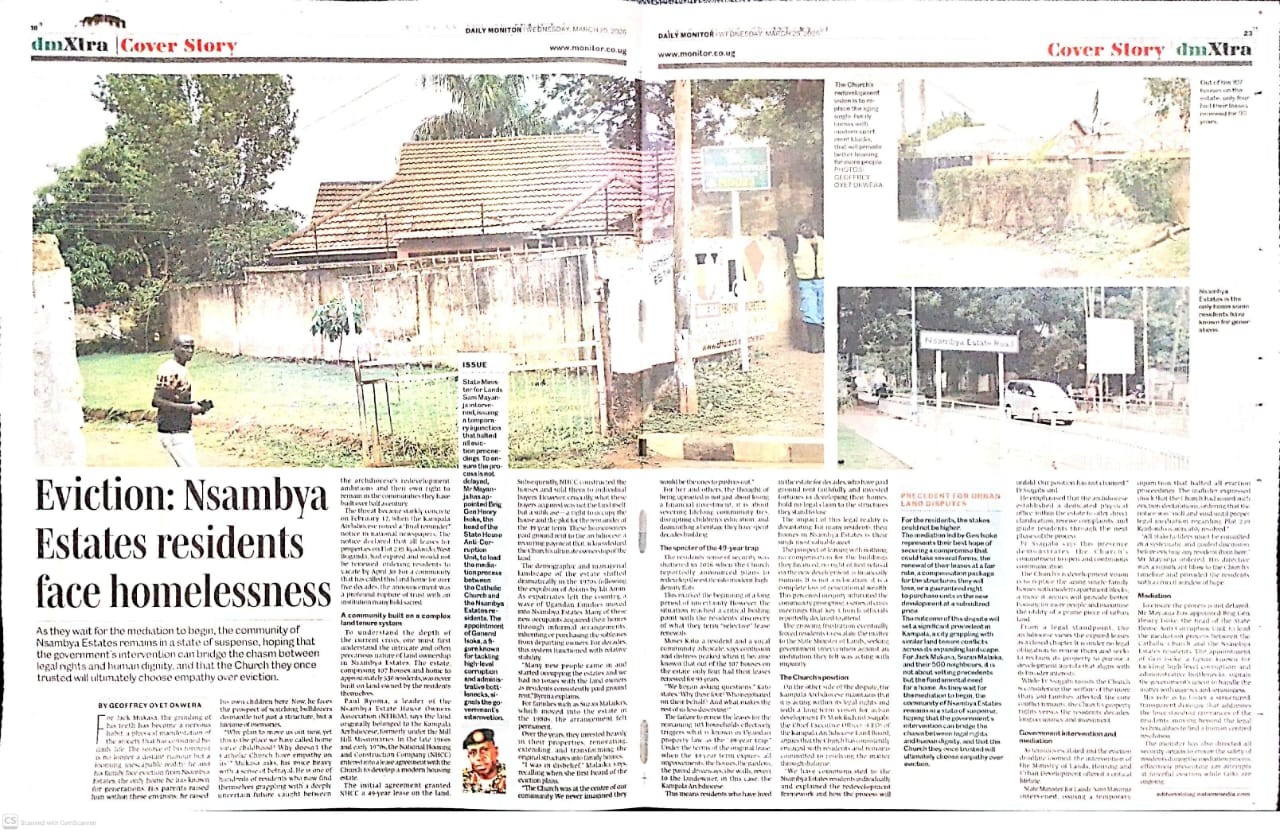
In the Daily Monitor of Wednesday, 25 March 2026, a story is told about a housing dispute that offers many lessons for us. The residents of Nsambya Estates, in Nsambya, Kampala, are facing an eviction. The final eviction notice was published in February, and the atmosphere has been filled with stress and anxiety since then.
While the looming eviction is legal, the estate dwellers have decried its illegitimacy. They do not understand how their landlord, the Kampala Archdiocese of the Catholic Church, can reasonably expect them to leave a place they have called home for decades. The residents have not only occupied the houses, but also improved them over the years. Some of them, whose parents acquired the premises in the 1980s, were raised there, and now raise their children there, and over the decades, have built a community they call home. This is why, even when the residents were individually first notified about the eviction in 2016, ten years ago, and reminders have been regularly given over the years, the shock prevented them from acting on it.
The most pressing concern, however, is that only four of the more than one hundred residents have apparently been allowed to remain via a renewal of their leases. This has been viewed by the aggrieved residents as discriminatory and therefore unfair. They claim that they are in good standing as the other four tenants. They have been duly paying their ground rents and have not had any other disputes with the landlord. Minus a publicly known criterion for the renewal of the leases, the aggrieved residents contest the acts of the landlord for inequity. It is this distress that caused the residents, through their association, to petition the Minister of State for Lands to intervene.
On the other side, the landlord, through the Kampala Archdiocese Land Board Chairperson, maintains that all their acts are lawful and have been legitimately pursued through regular private and public notices since 2016. As landlord, the Catholic Church contends that it has every right to deal with its land as it wishes and in that regard, it has decided to refurbish the estates by setting up apartment blocks, which will provide a more modern and equitable solution for the housing needs of many people in the Kampala capital. The tenants have had the notice of this plan and the non-renewal of their 45 year leases since 2016, the landlord argued, and a liaison office has been maintained physically on the land to help with any tenancy issues ahead of the due date of the lease termination.
The leases will not be renewed. That has been consistently notified to the tenants. In the circumstances, however, the question that lingers on is whether the affected tenants will be evicted after 30 April 2026, the due lease termination date? In response to the tenants’ petition, the State Minister for Lands issued a “temporary injunction”, or so it was reported, halting the eviction plans of the landlord pending a harmonious resolution of the dispute. Understandably, if not else, the tenants would want a considerable grace period at least. The matter was referred for mediation facilitated by the Head of the State House Anti-Corruption Unit.
It goes without saying that a place and community you have lived in for at least a decade is one that becomes home. Leaving, by will, is emotional. Leaving, by force, is even more emotional! It could be said that at some point, it felt like the estates would be the city-home forever. Why not, if you can do almost whatever you could do with your own residential home? If your parents stayed there, and now you do with your own family? But no, a leaseholder is not a freeholder of land. A leaseholder is not a perpetual owner of land. The legal interest in the land is capped. Once the duration of the lease expires, the ownership of the leaseholder also ceases. In law, such a leaseholder immediately and automatically becomes a trespasser, otherwise known as a tenant at sufferance. This is the problem with leases, at least for the tenant.
Leasing out land is one of the best ways of passively utilising land for a landowner who cannot otherwise develop or use it for some purpose. But for a tenant, a lease, especially one used only for residential purposes, is, although good, also a mirage of ownership that is not perpetual. For long leases, say where over two family generations have lived on the leased premises, the homey attachment is inevitable, and that is a trap of illusion. The regular ground rent payments eventually feel less like rent but more like utilities. After some accepted or ignored renovations are made, and tenants have taken on area political offices, and the original tenants have been succeeded by their children, the trap is sealed. The reality only dawns on the tenant when eviction later looms.
As far as the perpetual ownership and occupation of land in Uganda are concerned, nationals must hold the land via a freehold, mailo, or customary tenure. Leasehold tenure of land is not perpetual or forever. On the contrary, a holder of a kibanja (the right to occupy land forever, but not own it, yet sell or pass it to one’s estate beneficiaries after death—subject to a negligible annual rent), known as a lawful or bona fide occupant, holds it, all else equal, forever. This is a major differentiating factor for those who prefer to possess certificates of title for their land and end up settling for a lease. While a leasehold tenure offers the security of a certificate of title, including easier access to credit services, one must never forget that the lease will expire after some time. For a kibanja, however, its legal and security concerns not considered, occupancy of the land is almost forever. Consequently, for a national intending to purchase land, these factors must be weighed carefully, and advice sought from a trusted lawyer and realtor.
Turning back to the case at hand, the aggrieved tenants of the Nsambya Estates should understand their position legally and the interests of the landlord. Going combative is certainly off-putting to the landlord, and so also self-shooting. This is a case that requires high-level negotiations between the tenants through their association and the landlord. Certainly, some concessions and compromises from both sides should be expected, but the approach and tone of the tenants will be a major factor directing the flow and progress of the negotiations. The services of a skilled negotiator and property lawyer in this case cannot be overemphasised. Without proper negotiations, eviction may only be slightly delayed, but cannot be stopped.
Lastly, there are administrative issues with how the case has been handled so far. Can the minister legally issue a temporary injunction halting the eviction? Will the directed mediation achieve any success in the circumstances? Is it still proper mediation where the parties have not agreed on the mediator in the circumstances? Is the mediator, by virtue of his position and rank as an army officer, agreeable to both parties as a suitable and neutral facilitator? Has the principle of freedom to contract privately been upheld? Whichever the case, a legal battle should not even be an option in this case. That said, legal issues must be strictly avoided.
It is hoped that some of the subtle issues governing leases have been appreciated through this case study. It is also hoped that proper negotiations will be (or have been) commenced by the aggrieved tenants of the Nsambya Estates so that an amicable and innovative solution is reached.
Submitted,
Yours lawfully.
Disclaimer: The opinions shared here do not constitute or substitute proper legal advice. For any issues, please consult a trusted lawyer.
So, that was me, let me hear from you too…