
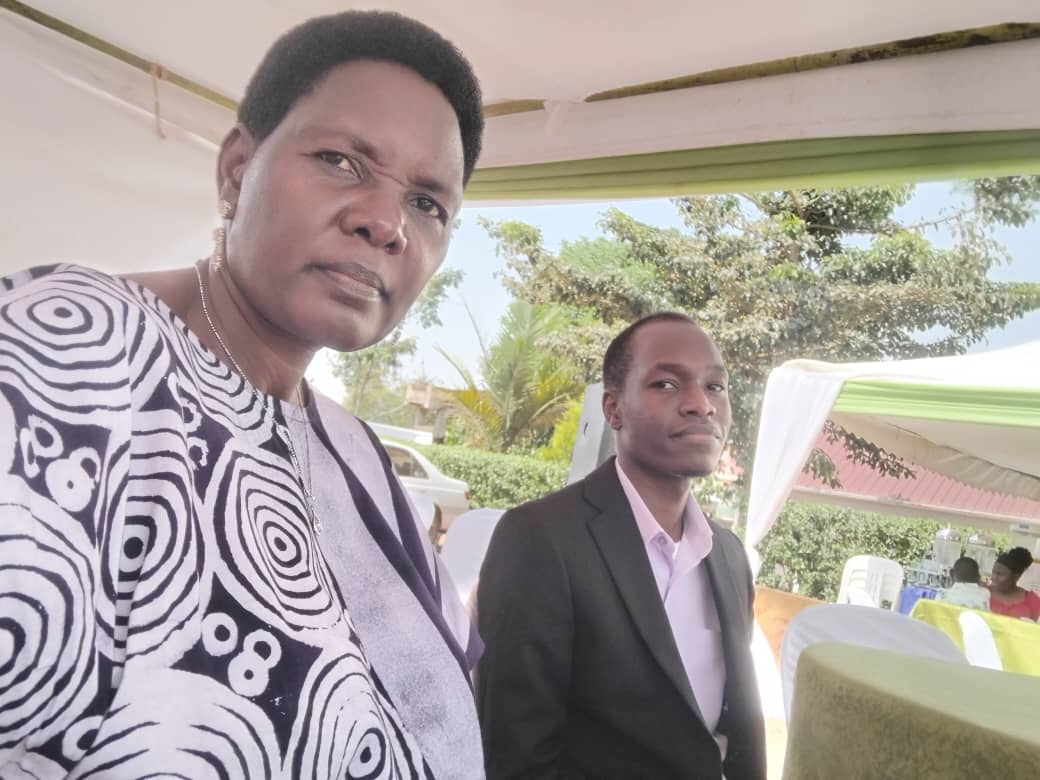
The first party I’ve attended this new year has been a graduation thanksgiving ceremony. I was with Maama as you can see in the photo above. Maama Claire, as we fondly call her, was giving thanks for bagging a Master’s degree in Education Management (Primary School Education). She graduated last year from the Islamic University in Uganda (IUIU), and had a party on the graduation day. But that was not enough, she decided to organize a special thanksgiving ceremony as well.
Joined by family, friends, colleagues, mentors, neighbours and the faithful parishioners and clergy of the still new St Theresa Bakka Catholic Parish in Wakiso District, we celebrated mass, had a few speeches, enjoyed a sumptuous lunch and then had the thanksgiving speech of the graduate, Maama Claire. The day was crowned with cake cutting, drinks, music and dancing. It was a warm party indeed.
Growing up, I’ve always experienced thanksgiving in church. It is something the ministers encourage and on some occasions even command. For example, in my village church, St Peter’s Kiyanja COU, a rule was passed by the parish priest that every couple who had a child baptised had to give thanks during the service in honour of that child. This is done in the manner of offertory, save that, for thanksgiving, one has the option (and it is usually taken, if not abused) to openly say a word and invite the congregation to join one in the thanksgiving by offering money or other items.
The thanksgiver, standing in front, holds a basket, and a song is sung as congregants queue up to offer something in thanksgiving on behalf of the celebrant. The politics of this mode of thanksgiving is that it is more competitive than it is religious. To save time, about three people will share the dais in thanksgiving, each holding a basket, with family and close friends standing in solidarity behind them. Which group is the biggest? Who will give the most money in thanksgiving? Who will attract the largest number of congregants supporting them? And when all is said and done, who will become certified as a Church Pillar by the Bishop? This is the politics of thanksgiving, but I digress.
Maama Claire’s thanksgiving party was not at all political. It was an intimate celebration of success and thanksgiving. Maama Claire and her family were our nextdoor neighbours back in 2003 when I became of school age. We have since remained good family friends. Other attendees were people she had worked with, lived with and grown up with. The event was also organized at her home. It was humble and beautiful. It reminded me of my parent’s thanksgiving ceremony in honour of their wedding silver jubilee in 2023.
As I sank into the ecstasy of the day, I thought about the virtue of a National Thanksgiving Day. Uganda observes many public holidays, most of which are internationally recognised. The remaining special national public holidays are political in nature, including the 16 February Remembrance of Archbishop Janan Luwum, who was assassinated by the Amin regime for criticising it. Others are usually ad hoc announcements, for example, the public holidays coming up on the 15th and 16th of this month for purposes of citizen voting in the 2026 general election. Therefore, none of the public holidays in Uganda are truly national (and I am not counting Independence Day because that’s political too).
We need a holiday which we shall truly celebrate as citizens, but not just use to rest from work or school. We need a holiday that will speak to us individually but also in our families and circles of friends. We need a holiday that comes with its own celebratory air and humanity. Like the past Christmas holiday is universally unique, we need a holiday that is devoid of political and other undertones. A holiday that will bring together the nation, touching individuals and families and our societies alike. And that holiday should be a National Thanksgiving Day.
I have seen Americans celebrate it in movies and on TV and I envy that. Instead of the many prayer breakfasts and lunches organised by the State House in a year, and stylised “national”, maybe we should adopt a National Thanksgiving Day, for us to reflect on what we have and where we have come from and celebrate that in earnest gratitude in our homes.
So, that was me, let me hear from you too…