
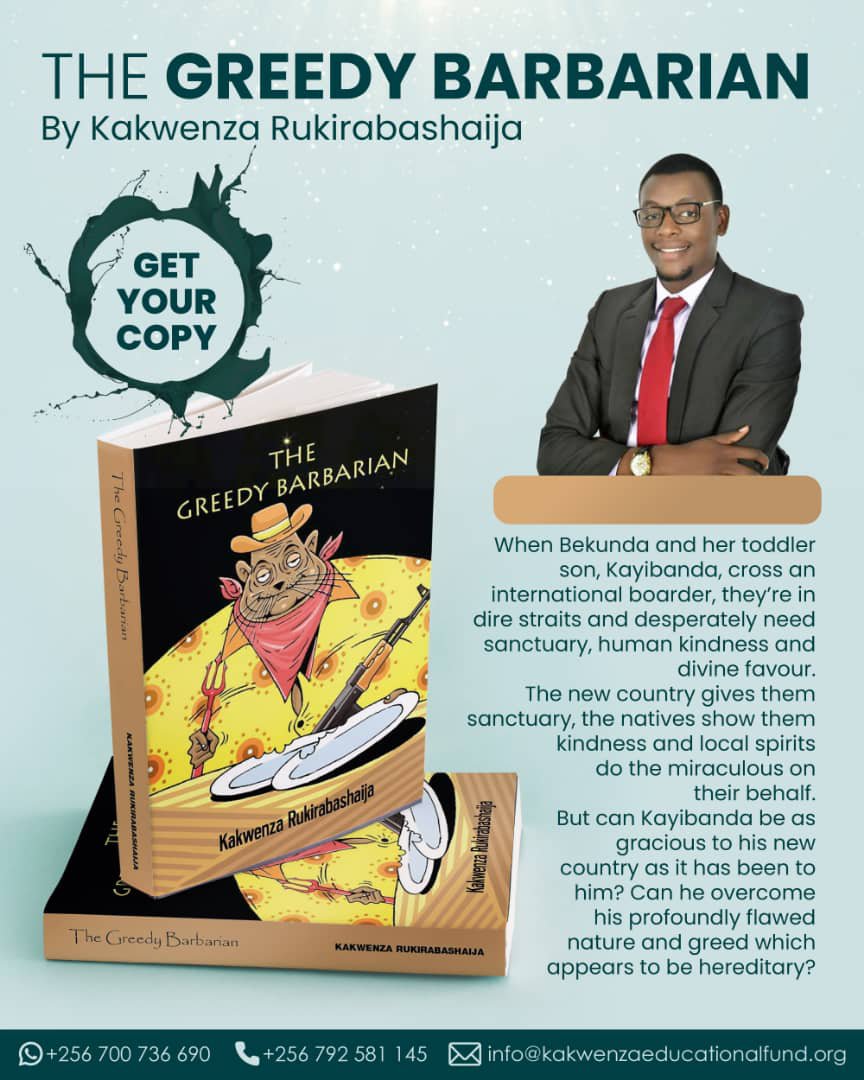
The novel, The Greedy Barbarian, by Kakwenza Rukirabashaija, is a satirical comedy that lampoons dictatorship. It revolves around the life of the protagonist, Kayibanda, in three parts: tracing his heritage and background; schooling, love life and marriage; political experience and leadership and finally his demise.
Like the title says, The Greedy Barbarian, is about Kayibanda, the greedy barbarian. The title is both descriptive and symbolic of the character of Kayibanda. The reader cannot help but quickly observe the greedy nature of Kayibanda right from his early childhood until he meets his death. And for being a barbarian, it cannot be overemphasised that he is actually alien to the country of Kalenga and that he is crude, ruthless and inhumane in his deeds. Indeed, these traits are mentioned in the text which says that ‘Kayibanda’s greed was insatiable’, and elsewhere that, ‘only Kayibanda the barbarian was left to campaign…’
Part One generally tells of Kayibanda’s heritage. It introduces Kayibanda’s great grandparents, grandparents, and actual parents. It is set in the rural parts of the country of Muhemba save for its ending in Kalenga. The time setting is pre-independence or colonial period as we see a people that are not yet infiltrated by western teachings and formalities. There seems to be no order of business generally, but yet that is the unfortunate order of the society. The novel sets off with the introduction of one of the major themes, Marriage and Family, by showing Rukundakanuzire and his wife, Ingabire’s dire need of a child, who later is Bekunda, Kayibanda’s mother. The motif of traditional spirituality is also introduced with the revelation that Rukundakanuzire is a night dancer. He, however, regrets the unfortunate habit in a stream of consciousness where it is revealed that he inherited it from his father who also got it from his mother. From the onset, the author warns the reader not to make any mistake as regards any good thing coming out of Kayibanda. It is made clear that his is a family of problems and mystery. The theme of Love is also introduced through the worrying of Ingabire about his husband wherever he is away at his secret unfortunate habit. Sometimes, he is back by dawn, other times, he does not make it in time and is then forced to spend the rest of the day hiding his nakedness in the symbolic coffee bushes. Such are the times when his wife needs him the most for example when she gives birth to Bekunda.
Rukundakanuzire is rather reactionary and so ruthless in his mean that he spears Bwengye to death despite his civility in seeking Bekunda’s hand in marriage for his son, Baryabusha. This is the beginning of the incessant and indifferent motif of malice, vengeance and death that keeps showing as the plot advances. The satire is in how the killers do not show the smallest hint of contrition for their violence and bloodshed. And as is now expected, Baryabusha takes his payback and poisons almost half of his nemesis’s cattle and successfully kills Haleera, Rukundakanuzire’s eldest boy. This chokes Rukundakanuzire so much so that he seeks refuge in relocating from the village of Buregyeya to Mubaya. This is the first occurrence of a journey. It is also the first mention of the motif of journeys, treks and migrations. This removal to Mubaya is similar to that of the Israelites from their country to Egypt, during Joseph’s Biblical times. That while it initially appears as relieving, it later turns out to be enslaving and tormenting.
It is in Mubaya that things fall apart in Rukundakanuzire’s homestead. First, Bekunda is gang-raped from the symbolic cotton bushes. She hides this ordeal and when she conceives, not even the murangi can induce the gods to save her from the punitive death she has to suffer for the one crime she didn’t commit but rather suffered victim. The crime of conceiving outside marriage compels her to remove from her family to her aunt’s for refuge. Again, here we see a combination of the malice and journey motifs working hand in hand to advance the plot and as well the themes of Love and Marriage and Family. Rukundakanuzire, as the head of the family, is now put to test – will he overcome this huge setback and reorganise his homestead to regain its state of serenity?
On an empty stomach, he treks to seek the aid of the murangi who prays to the gods and his (Rukundakanuzire’s) quest of vengeance is granted. He, however, asks for one other thing that surprises the reader at this stage. He wants to stop the habit of night dancing! This is the first clash-point we see as previously Rukundakanuzire seems to regret this habit but later seems to enjoy it as he does it ‘out of his own volition’. Now, in another stream of consciousness, Rukundakanuzire does not lose this rare chance of the intervention of the gods in his worries. The author, through this clash-point, drives the lesson home, that people ought to beware of their bad habits as they often grow to become fixations or simply addictions. It is this very reason that the author goes ahead to show how Rukundakanuzire almost loses his life for having breached the night dancing pact that was entered into by his forefathers. Again, the lesson is that addictions, though very difficult to overcome, can still be triumphed upon once the victim has the will. Again, we see the combination of the treks, vengeance and traditional spirituality motifs being used to advance the plot from Rukundakanuzire’s homestead to Bekunda’s wanderings with Kayibanda, but also the themes of Love, Marriage and Family as well as African Tradition; and the traits of the characters at this stage. The particular event of consulting from the gods also allows the reader some room for breath by creating some humour after the agonising sexual harassment occasioned on Bekunda. Not forgetting, luck as a motif is also introduced with Rukundakanuzire surviving death and Bekunda escaping death. By and large, Bekunda escapes death, Runkundakanuzire exerts revenge on his daughter’s tormentors and gets rid of the night dancing habit, but that is not all.
Unfortunately, for him, the tiring events that unfold one after the other, causing him to lose his social status from richest to one of the poorest, his loss of, Bekunda, his firstborn child, and resettlement in another village away from his ancestral home overwhelm him and he cannot remain the same. He fails to take charge of his household and loses his beautiful wife and Umwiza, his last-born child. He gives in to drinking and his family breaks down right from its very foundation. This comeuppance foreshadows the fact that, Kayibanda, later as head of state, is overwhelmed by his newly found peace – the peace of power and being in control and he ends up sending the country for which he is head of state, to the gallows. To explain it further, the premonition is premised on the irony that lies within these two characters’ respective experiences. That in fact, both Rukundakanuzire and Kayibanda are not met with challenges at the time of their respective failures. They have both overcome their apparent challenges and the only plausible expectation is a success and victory song at the end of the day. While Rukundakanuzire has been assured of his daughter’s life and that of her unborn child (survival of death), successfully revenged against his daughter’s afflictions, and managed to escape from the wrath of Baryabusha, and established fear among the people of Mubaya in order to suppress any future malicious attack on his household; Kayibanda, on the other hand, has just toppled his political opponents and is now the President of Kalenga. The question is, how then do they fall after climbing to the peak of their mountains?
Another clash-point that is prone to observation by a keen reader is the use of modern words in ancient times. It baffles the reader how in ancient and typical African setting, Umwiza says, ‘bye, Daddy’, to Rukundakanuzire instead of ‘bye taata‘ as is expected. In my view, the misplacement of this modern word could have been omitted by reporting the farewell instead of direct speech. Be that as it may, one can also argue that it was intended to symbolise the obscurity of narrating from a historical perspective.
The reader will also observe the underlying themes of Sexual Immorality, Social Class and Stratification as well as the Insecurity of the Female Gender, which can be viewed as Gender Inequality. The Insecurity of the Female Gender can be illustrated by Ingabire’s perseverance of her husband’s vile character and Bekunda’s befallen fate of being a single mother and her troubles and uncertainties as regards getting a husband. This is heightened by Bekunda’s solace in prostitution and sex which is yet another motif that advances plot as it is the reason for Bekunda’s migration from Muhemba to Kalenga.
One other theme or rather idea that is introduced at the short-lived reunion of Bekunda and Ingabire and Umwiza is Religion (Christianity). It is revealed that Ingabire is now a proselyte, which wins her economic and social independence but does not restore her family and reunite her with her husband. The reader is left in suspense as to whether the author intended to bring out religious hypocrisy or not as a theme or idea. What is not in dispute though is that this religion later ushers in the theme of Education yet beneath it again lies suspense as to the rationale for this education. This is because the majority of those who have attained this education are using it to sabotage the economy of Kalenga in their favour. There is a sheer lack of work ethics and integrity among the leaders of Kalenga as is later illustrated.
Fast forward, Bekunda’s beauty for which she is described as a ‘head-turner’ brings both pluses and minuses. She effortlessly thrives in the business of sex and is able to take care of herself and her son, Kayibanda. However, because of this same beauty, jealousy and malice are aroused in her business competitors who plot against her leading to losing her ear, arm and some teeth. Again, she survives out of sheer luck. She recovers completely and is able to make yet another journey and migrate to Kalenga. As Part One ends, the reader appreciates the trinity despair that occurs threefold. First is Rukundakanuzire’s horror of the night dancing, the pain of poverty and the horror of losing Bekunda and later his wife. Second is the suffering of Ingabire in putting up with a night dancer and standing the vile character of his husband and the witnessing of her marriage break down. The third is the anguish of Bekunda in experiencing the rape and raising a fatherless child, her troubles in finding herself a husband coupled with prostitution and now having to face life as a disabled woman.
In Part Two, Bekunda is now permanently in Kalenga and is looking forward to a dejâ vü. Again, luckily, the saviour is Kagurutsi. And this migration when contrasted with that of Rukundakanuzire’s reveals this one like the Biblical exodus of the Israelites from Egypt, the land of slavery and bondage to Canaan, the land of milk and honey. Indeed Bekunda’s troubles come to an end as it is written that, ‘The trio was now a happy family. Kayibanda was happy; Bekunda was happy: and so was Kagurutsi.’ This is the trinity ecstasy. It marks the beginning of the rise and fall of Kayibanda. On a plot curve, this is the rising action. This part of the novel is set in Kalenga: Malanga, Biguri, and Mpara. The time is now somewhat post-independence or thereabouts and the society is much developed and organised. The book is now rotating around Kayibanda. And all that the author does now is to labour to give the reader as many illustrations of the two outstanding traits of Kayibanda. The reader can now begin to resonate with the title, The Greedy Barbarian. This is not only in line with the text but also in line with its relevance in today’s society, especially Uganda, our motherland. The author is visibly excited and he cannot help, hence, throughout this part, he occasionally foreshadows what will unfold in Part Three. The reader can now foresee how the plot will unfold, Kayibanda will go to school, then form political intentions and later on become President. This is what exactly happens. The reader is made witness to the growth and development of greed and barbarism in the character of Kayibanda. As soon as the author settles the new family of Kagurutsi, Bekunda and Kayibanda in Malanga village, he is quick to steal a glimpse for the reader when he writes, ‘Kayibanda was an ambitious young boy but a loner…Kayibanda was vulgar and harsh towards those who disagreed with his views and opinions. He had perhaps been infected by the vice that had inflicted Rukundakanuzire, his grandfather. This cantankerous demeanour would haunt him throughout his life and it always made people around him fear to oppose or correct him’ This statement creates suspense and anxiety in the reader who will quickly go over the next pages until they are in Part Three of the novel. The author’s excitement is of help after all. It also excites his readers.
I will make a quick observation of this statement especially the part which alludes to Rukundakanuzire. Here, the author wittingly helps the reader to identify his use of a doppelganger of Kayibanda in the character of Rukundakanuzire. The effect is that by the time the reader gets to the real protagonist, they are not suddenly shocked by their unrepentant deeds of evil. However, like every doppelganger, the two characters are essentially different in their discretion. That whereas Rukundakanuzire is shown to be remorseful for some of his acts such as night dancing through the various streams of consciousness and the cold blood murder of Bwengye when he does not choose to do the same vile thing when presented with the rogues from Bulanda village that raped his daughter, but opts to forward the matter to the chief of the village; on the other hand, Kayibanda is shown to be inherently wicked. He does not show any slight remorse for his acts and when he does, it is not out of contrition, but rather his cunning shrewdness. At one moment, the reader is left in suspense when Kayibanda appears to have a stream of consciousness that later turns out to be a spasm of the combination of precariousness, ingenuity and megalomania. In fact, it cannot be overemphasised that Kayibanda dreams evil, thinks evil, enjoys evil, sees evil and does evil. For Kayibanda, it is evil after evil after evil after evil! It can be said that now, the author seems to make a hidden inference that Kayibanda takes after his true father, one of the rogues that gang-raped the innocent Bekunda; for most certainly the difference in intent between him and his grandfather does not endorse the proposition that ‘Like Rukundakanuzire, like Kayibanda.’ As the old adage goes, indeed it is, ‘Like father, like son.’
The events that follow amplify the sharp contrast between Kagurutsi and Kayibanda. While the former is the epitome of civility, the latter is the epitome of animalism. It goes without saying that as the reader flips the pages, there is a sense of the sheer need to tame Kayibanda that crops up on them with utter disdain. This is as a result of the multiple illustrations of the malice and vengeance motifs. It should be noted that the author is excited at this stage and because of this, the events are so vividly described that the reader (especially one who will be examined on the text) is saved the burden of reading between the lines to dig out the traits of Kayibanda. Everything that you must know and not confuse is put out clearly as you skim through the pages. The excitement is that of one who understands very well the society they are writing about and to be precise, it’s like that excitement with which the Late Godfrey mwene Kalimugogo writes about Uganda General Company (UGECO) and describes its head, Boss, in his A Murky River.
Fast forward, Kagurutsi hatches a plan to journey Kayibanda to Chief Bamwine’s where he is not the most unwanted person. This journey motif advances the plot from Malanga village to Mpara town, where Kayibanda starts his infamous political career. It also enhances the themes of Education, Marriage and Family, Love, African Tradition and Social Class and Social Stratification. At Biguri, Chief Bamwine welcomes the uninvited guests and humbly takes in Kayibanda as his own. Again, it is not long before Kayibanda is unwanted in Biguri. This compels Chief Bamwine to take Kayibanda to a boarding school. Here it is introduced to the reader that Kayibanda has a passion for ideological studies and invests in the teachings of communism at the expense of his school books. As a megalomaniac, he prides in boasting over his relation to the Chief and this gives him a bit of consolation to the fact that it is increasingly impossible for him to think of new crimes to commit. Soon he joins the high school at Mpara town and runs away from Chief Bamwine’s and while here, his greed for money and lust for girls earns him an expulsion together with Kamagoba, with whom he elopes. Again out of luck, the two manage to get scholarships to study at Tanya University.
Back at home, there is a clash of interests. Bekunda wants Kamagoba, the educated, for Kayibanda while he wants Kembaga, the villager. Kayibanda will have his way through as he always does. He hatches a plan to exterminate Kamagoba. As absurdly normal for him, he does not feel even an iota of remorse for this. Kayibanda is now bereft of one to look after his son, Rwehakanuzire and he runs to the waiting arms of the illiterate Kembaga. At this stage, it is apt to make mention of the author’s witty nomenclature and craft of the names of the characters and setting. For Ugandans who have read the literature of our history, the name Kayibanda is one that you would relate with because of its strong representation of the present head of state. The Chief Bamwine and others are all a representation of his biography. Names such as Mpara and Tanya are a kind of pseudo names of Mbarara and Tanganyika/Tanzania and others as the reader will see. There is no doubt that the novel is very relevant to Uganda’s political history and set up.
Part Three is set in the country of Tanya, Europe and chiefly in Mpanga, the capital of Kalenga. It is now clearly post-independence and the contemporary times. This is the long-awaited narration of the author. It cannot be overemphasised that he is unable to control his pen. He uses the technique of authorial intrusion and steps into the ring and then directly speaks to his audience, the reader. It does not feel like a narration anymore, but rather what you would call an aside, monologue and/or epilogue in drama. It goes without saying indeed that most of Part Three is a historical allusion of Uganda’s post-independence political woes and this is very direct as the President Ongoi ousts the former, Okot while he away attending a Commonwealth Heads-of-Government Meeting in Singapore. As I said, the author is now at the point of narration that he mostly likes and it feels like a kind of anecdote – a political history tale of Uganda within the novel. Following that, the kind of epilogue sets in when he tells of experiences not alien to Uganda, such as the constitutional assaults that have happened.
These are the present-day Ugandan affairs. And this is where I find the challenge. Up until this point, the reader follows nonstop. The storyline is like one long sentence that is only separated by commas, semicolons, colons and dashes to allow the reader some room for breath, but never a full stop. Not even the separation of Part One and Part Two gives the slightest semblance of a period. The first of its kind is first encountered in Part Three. This is where the novel stops shifting. In fact, a critical reader would take longer than the time they spent reading the first two parts. Due to the authorial intrusion, the description is so vivid that continuously the reader will stop to nod in agreement of the events as they unfold and/or to shake in utter dismay of what lies beneath the political system and leadership of Kalenga. The effect is so great that you don’t have to be seated next to someone for you to start ranting and surf the internet to ascertain some of the events as facts. This effect can be summarised in the words of a popular quote from Francis Imbuga’s Betrayal in The City. That ‘when the madness of an entire nation disturbs a solitary mind, it is not enough to say that they are mad’. There is a lot for the reader to digest and this is why I would have preferred a Part Four of the book owing to the fact that the climax, falling action and the conflict resolution all take place in Part Three. The trouble the author goes through in compressing the events is evident and that is what forces the reader to cover the book, keeping the index where they had stopped, and then start a replica of the discussions that are aired on the radio political talk shows. That where the author mentions one example, the reader supplements with nine others either to themselves or to the irritated neighbours. If asked, I would rather the author employed the technique of dialogue here because of its ability to mitigate the effects I have described. An example is the critical analysis of similar literature in form of plays such as Nikolai Gogol’s The Government Inspector where the social injustices and political inefficiencies are discussed among the characters with the witty expressions and diction of verbal speech which heightens the satire and its humour. However, for The Greedy Barbarian, it can be said that the author’s intention was to present his arguments in the greatest tone of contempt and ridicule. The effect on the reader is feelings of contempt, disappointment, anger and defiance towards the Kalengan leadership and others like that in today’s world.
Kayibanda grows from a presidential secret assassin to a Government Minister, rebel leader and finally the President of Kalenga and as it’s often said, the rest is history. The climax of the conflict is reached when Kayibanda becomes President of Kalenga and his tenure is simply the falling action of the plot. The thematic problems of Autarchy, Corruption, Social Injustice and Political Inefficiency are very generously illustrated. Think of whatever you would think of in relation to the above and you will find even more than that in this unfortunate and highly symbolic Kalenga. Like I had mentioned earlier, Kayibanda’s doppelganger, Rukundakanuzire, is nowhere close to him. The problem with Kayibanda – greed and barbarism, is in him and no amount of counsel can change this. For Kayibanda, it is evil after evil after evil after evil. The author’s tone is that of resignation as relates to the change of things during Kayibanda’s tenure. Here he employs the technique of negative capability most common in poetry, and whose effect is that somethings cannot be solved but have to be left where they stand until time takes its course and takes away the problem. Here, the author exemplifies this by illustrating the initial failures and troubles of Kibaate, Kayibanda’s foil and hero of the novel. This mood of resignation pushes the style of negative capability through which then after the next ten years from the present, the conflict is finally resolved with the death of Kayibanda and most of his family members and cronies.
There is a sense in which it can be said that the author uses so much wit and skill in avoiding the literary adoption of a Deus ex Machina, which is usually criticised, in both the characters of Kagurutsi and Kibaate. He qualifies them as plausible saviours of the day. This must be appreciated specially.
Finally, the author turns into a prophet who foretells how Uganda will finally be redeemed by a today’s Besigye/Muntu/Kyagulanyi/Mao/etc. in the character of Kibaate who ushers in a period of renaissance for Kalenga/Uganda. The political reforms and his presidential gesture is similar to that of the Late President of South Africa, Nelson Mandiba Mandela and there is some light humour in how Kalenga is headed to be a first-world economy.
In a nutshell, Kakwenza Rukirabashaija’s The Greedy Barbarian is one of its kind. Its chronological structure in terms of the character of Kayibanda and the country of Kalenga, as per the history, the present and the future of the symbolic picture of Uganda shows that he is indeed a trained journalist but much more than that, he is a great writer and what’s more, a genius professor of fictitious writing. This best-seller novel is a must-have, must-read and a must-ponder-on piece of literary work.